top of page
Discover the Alternative to the Modern-Day Textbook

.png)

Explore the Pythagorean Theorem with this story task that is a play on a timeless pirate tale. The crew of "The Deceit" can gain amnesty with your help! Solve a variety of challenging Pythagorean tasks and find your way to the "Chest of Broken Souls." As a pirate, you will apply your problem solving and critical thinking skills to help put an end to the notorious Davy Drake's reign.
.png)
Skill 1: Perfect Squares
To square a number: multiply it by itself.
.png)


Skill 2: Square Roots of Perfect Squares
.png)
A square root goes the other way:

A square root of a number is ...
... a value that can be multiplied by itself to give the original number.
A square root of 9 is ...
... 3, because when 3 is multiplied by itself we get 9.

Skill 3: Estimating Square Roots of Non-Perfect Squares
.png)
It is easy to work out the square root of a perfect square, but it is really hard to work out other square roots.
VIDEO LESSON


1


Directions: Utilizing the video lesson and the notes provided, answer the following questions. Attached in your Google Classroom is a Google Doc that you will enter your answers. Enter your answers in the tables provided within the document.


Skill 4: Calculating the Hypotenuse when two legs are given in a right triangle.
.png)
Over 2000 years ago there was an amazing discovery about triangles:
When a triangle has a right angle (90°) ...
... and squares are made on each of the three sides, ...
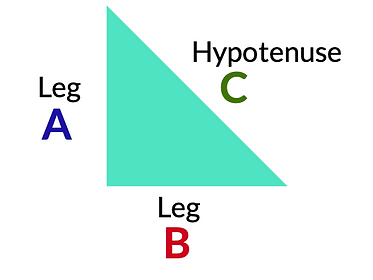

... then the biggest square has the exact same area as the other two squares put together!
Video Lesson


2
Directions: Utilizing the video lesson and the notes provided, answer the following questions. Attached in your Google Classroom is a Google Doc that you will enter your answers. Enter your answers in the tables provided within the document.


Skill 5: Calculating the length of a leg when a leg and the hypotenuse are given in a right triangle.
.png)
Video Lesson 1
Video Lesson 2

So hmmmm..... What do we do if the hypotenuse of a right triangle is given?

STEP 1
Well we know that Leg A = 6 and the Hypotenuse = 10, so that means we have to figure out the length for Leg B.


STEP 2
Now you find the difference between the square of Leg A and the square of the hypotenuse.


STEP 3
Finally, find the square root of the difference. So, you will find the square root of 64 for this problem. This will give you the length of LEG B.


3

Directions: Utilizing the video lesson and the notes provided, answer the following questions. Attached in your Google Classroom is a Google Doc that you will enter your answers. Enter your answers in the tables provided within the document.


bottom of page